

In June, British Labour MP Steve Yemm stood in Parliament and asked a question about artificial intelligence – “Who is shaping whom?” It was a reasonable concern, made all the more interesting by its unusual delivery. When his remarks were run through Pangram, an AI-detection tool, the speech was flagged as entirely machine-written. The episode has an almost delicious irony – a politician warning about technology’s influence while apparently relying on that technology to find the words.
In September, The Economist reported that roughly one in ten words in British parliamentary debates are flagged as AI-written or assisted, up from almost none in 2024. Australia performed more strikingly in its comparison of English-speaking legislatures, with over a fifth of words sampled from the House of Representatives being flagged. These are admittedly detection estimates, rather than proof of authorship, and editing assistance will always be difficult to distinguish from wholesale generation. Still, the scale is worth considering. Parliament appears to be acquiring a new and rather anonymous speechwriter.
The Business of Sounding Sincere
Political speeches have never been the solitary creations of those who deliver them. Prime ministers employ speechwriters, ministerial offices circulate talking points and backbenchers rely upon entire teams of staff to polish their remarks. It would be absurd to suggest that an MP who asks an assistant to draft an intervention is committing democratic fraud. Indeed, the romantic image of a representative composing every sentence in a lonely study bears little resemblance to how Canberra or Westminster really operates.
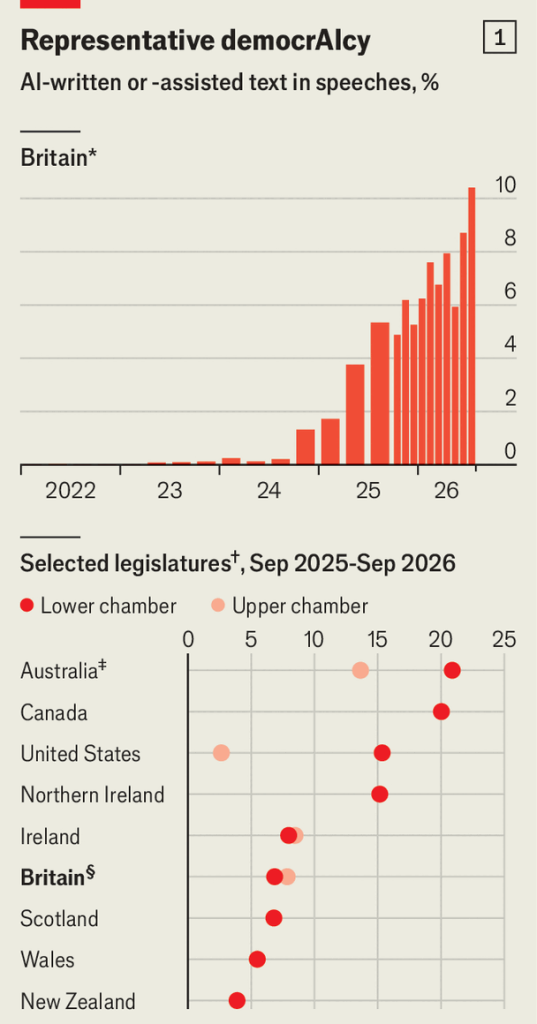
AI changes the arrangement in ways easily overlooked. A human speechwriter learns a politician’s convictions and knows the constituency, the arguments that have failed before and which words would sound absurd coming from that particular mouth. A chatbot knows the statistical habits of political prose. Asked for a statement about a hospital closure, it can produce dignified concern and a promise of accountability before anyone has decided what ought to be said, while sounding perfectly plausible. Of course, there are always the same clichés. There is the solemn declaration that an issue concerns more than figures on a spreadsheet, the inevitable invocation of future generations and the all-too famous pivot towards “shared responsibility”. Repeated across dozens of speeches, these phrases create an eerie sameness, as though representatives of different electorates have converged upon a singular way of expressing concern. It seems that AI has only accelerated the empty rhetoric that politics is known for.
What Happens to Representation?
Writing is often how people discover weaknesses in their own arguments, forcing choices between incompatible claims and demanding an explanation of why one policy should prevail over another. A member who lets software perform that work may save an hour, but they risk surrendering the intellectual exercise for which the hour was valuable. Consider a speech on migration. It is easy to ask AI for an argument that acknowledges humanitarian obligations while emphasising pressure on housing. The result will probably be agreeable enough. It will be harder to tell whether the member has weighed the consequences, consulted local constituents or thought seriously about where the balance should fall. The words may be accurate and the sentiment sincere, but what’s really the point?
Of course there are practical distinctions worth acknowledging. AI can help an understaffed electorate office summarise legislation or improve a clumsy draft, and those hours saved may genuinely be returned to constituents. Parliamentary speeches, however, occupy a different place in democratic life. Hansard records positions taken by elected people, available for journalists and voters to revisit long after the sitting ends. An argument entered into that record ought to carry the weight of someone having made it.
The Value of an Imperfect Voice
The Economist also found that British voters were markedly less comfortable with politicians using AI to write than with many other professionals doing so. We may be quick to dismiss that reaction as technophobia, but it may also reflect a reasonable expectation that representatives should be answerable for the reasons they offer. Voters can forgive an awkward phrase when they believe the speaker means it, but they have less reason to welcome exquisitely phrased sincerity produced on demand.
The response need not involve banning every AI tool. Politicians should disclose substantial AI drafting and remain responsible for every factual assertion, as Yemm did. More importantly, they should resist treating the act of making an argument as clerical or logistical work. We elect representatives for their judgement, including the occasions when their words reveal its limitations. A parliament filled with polished speeches has little value if nobody ever struggled over what they mean. The danger is that AI may leave us with more political language than ever, and fewer voices worth listening to.



Half of Parliament sounded like it was written by a robot long before ChatGPT came along…
Over 20% in Australia?? That’s actually quite concerning if the figures are accurate.
Big if, those AI detectors aren’t exactly reliable.
Politicians have had speechwriters for decades. Don’t really see why using AI is suddenly such a scandal.
The Steve Yemm example is hilarious, you really couldn’t make it up 😂
So we’re paying MPs hundreds of thousands a year to read out ChatGPT essays. Brilliant.
At least the speeches might be grammatically correct for once!
I don’t have a problem with an MP using AI to help with research or paperwork, but surely they should be able to explain their own policies without it.
Wouldn’t be surprised if half the ministerial press releases are AI generated already
I wonder how much of this is just staff using AI to clean up drafts. That’s a pretty different thing from getting it to write an entire speech.
If AI can get politicians to stop saying “hardworking Australian families” every five minutes I’m all for it.
The disclosure proposal sounds reasonable but how would anyone actually enforce it? It’s not like you can prove which sentences were written by a chatbot