
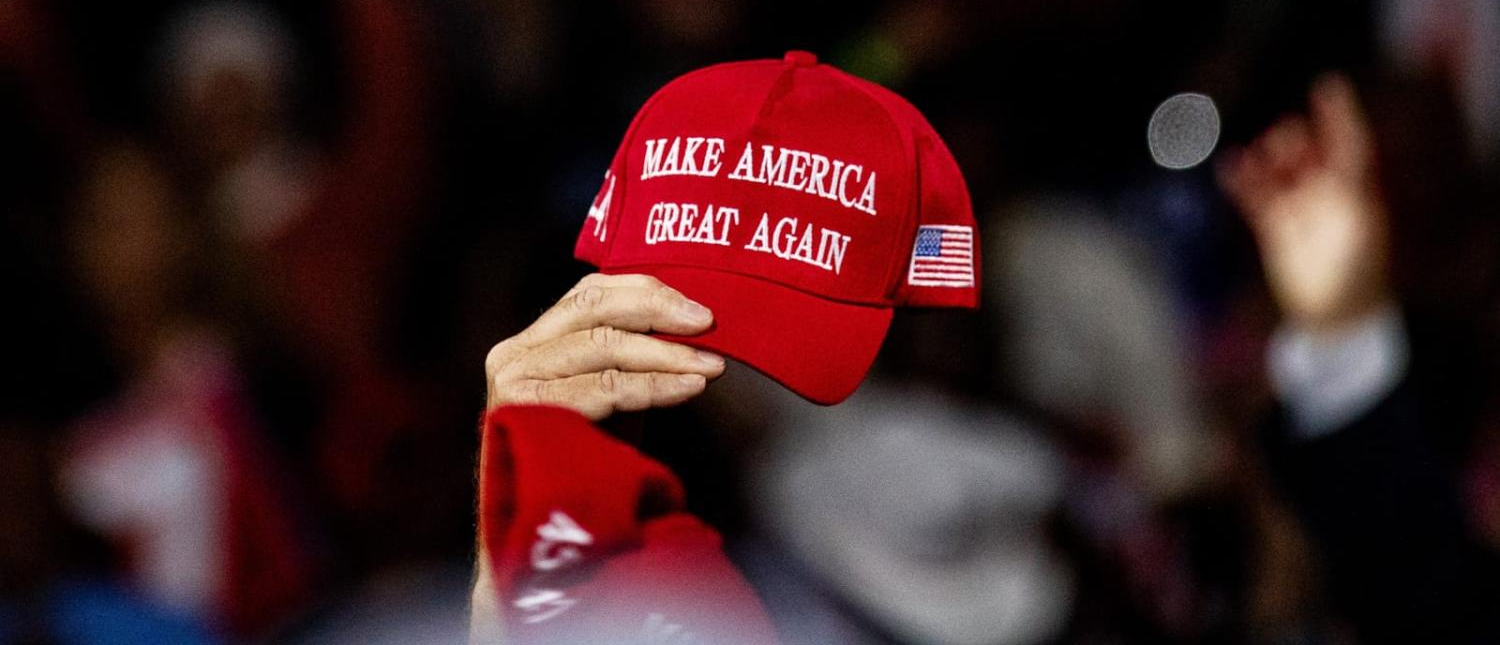
‘Make America Great Again’ stands as one of the defining political slogans of the 21st-century, not because it is detailed, but because it condenses an entire political worldview into four simple words. Beyond merely advertising a candidate, a strong political slogan diagnoses a national condition and offers a remedy. MAGA does both at once.
The slogan suggests that the United States was once great, that it has since declined and that this decline can be reversed through political action. In that sense, it offers a story within a potent campaign message: a past to be recovered, a present to be corrected and a future to be reclaimed. This is an incredibly powerful structure. Rather than asking voters to absorb an exhaustive list of policies, it provides a broad interpretive frame through which each policy can be understood. Trade protection, immigration restriction, industrial revival, military strength and cultural conservatism can all be presented as components of the same broader mission of restoration.
This is precisely what gives MAGA its unique force. The average voter does not experience politics through detailed policy analysis, but through stories, symbols, emotional cues and moral frames. Rather than technical language or ideological jargon, MAGA immediately instills a sense of loss and transforms it into a promise of renewal. This combination of grievance and hope is politically potent because it allows dissatisfaction to be felt not as despair, but as motivation.
Nostalgia and Ambiguity
The emotional strength of the slogan lies largely in its appeal to nostalgia, primarily through the word ‘Again’. Beyond simply referring to the past, it reassures voters that the nation’s best days have not vanished beyond reach. Particularly during periods of immense cultural, economic or social uncertainty, restoration serves as an incredibly attractive promise.
Above all, MAGA’s brilliance lies in the fact that it never specifies exactly when the United States was ‘Great’, what that greatness consisted of or for whom it was available. It is precisely due to this ambiguity that the slogan fulfils its purpose so effectively, enabling different audiences to project their own meanings onto it. A manufacturing worker may hear a promise of economic revival and secure employment. A social conservative may hear a desire to restore traditional moral or cultural norms. A nationalist may interpret it as a call for renewed military prestige and geopolitical dominance. Others may simply hear a more general promise of competence, order and national pride.
Because MAGA remains inherently open-ended, it can unite those whose precise visions of the past may differ significantly and who do not need to agree on the exact details of what ‘greatness’ entails. It appears specific enough to be forceful, yet vague enough to gather a plethora of political frustrations and aspirations under a collective banner.
Linguistic Simplicity
With respect to linguistic form, MAGA is also highly optimised. It is short, direct, rhythmically balanced and easy to remember, which provides a blunt clarity and impressive cadence. Thus, it avoids the pitfalls of appearing exceedingly abstract, bureaucratic or overqualified typically associated with political language. Indeed, it sounds like ordinary speech, and that provides unique accessibility.
Grammar also matters. The phrase is an imperative: ‘Make’, instilling a powerful sense of momentum and urgency. Yet unlike more overtly hostile imperatives, it is framed in positive language without prohibition or negation, enabling it to sound assertive and not exceedingly technical or severe.
Simultaneously, each word performs a distinct rhetorical function: ‘Make’ signals action, ‘America’ establishes the collective object of concern, ‘Great’ names the desired end state, but in a form broad enough to remain emotionally resonant rather than analytically precisee, and ‘Again’ introduces a concept of memory, decline and the promise of return. Very few slogans manage to combine agency, identity, aspiration and nostalgia so compactly.
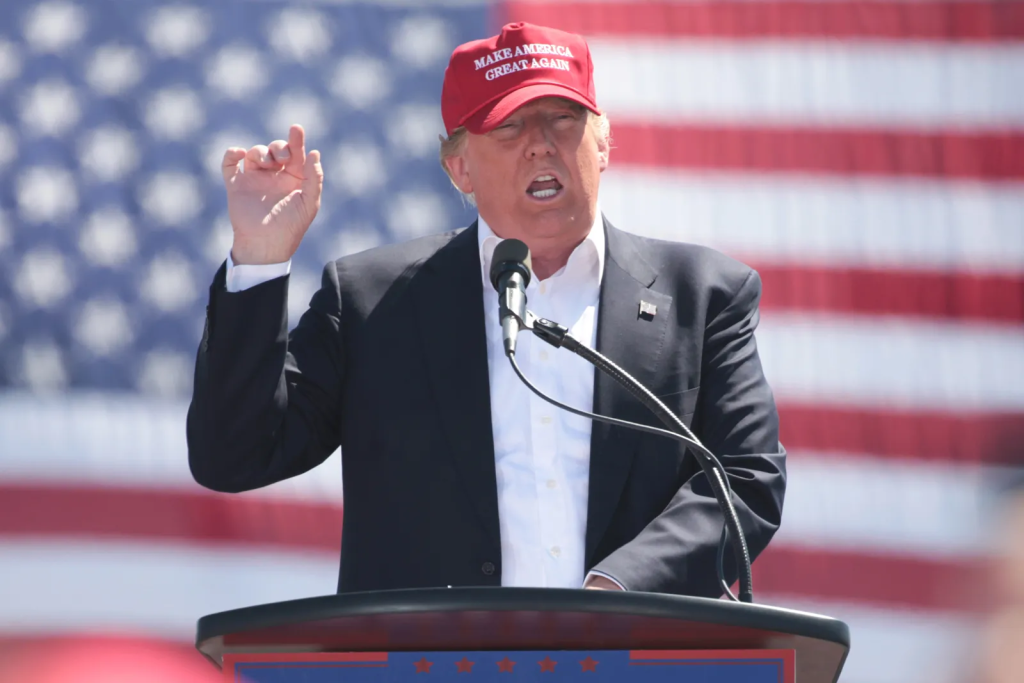
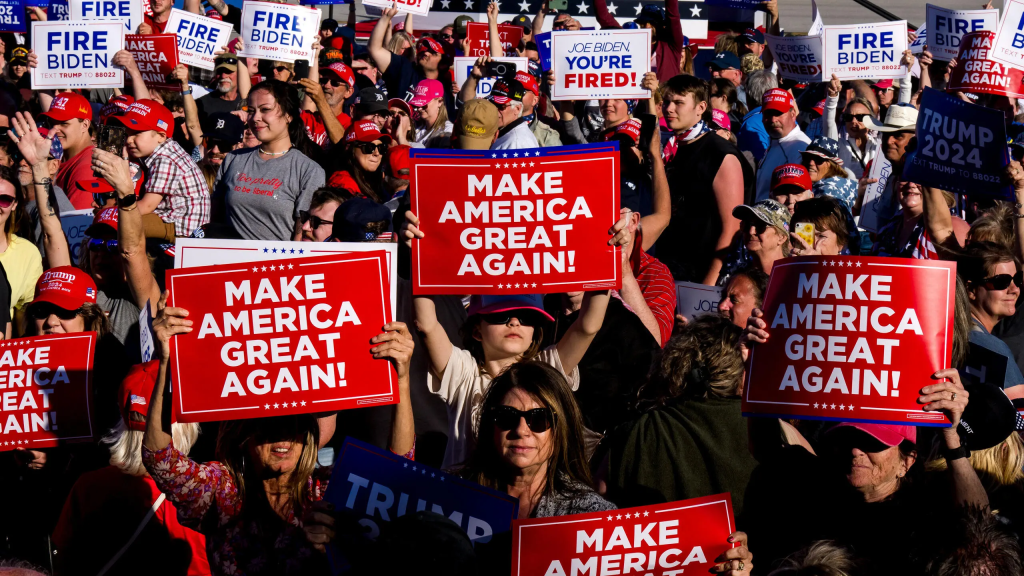
The repetition of the slogan has only amplified its force. Repeated across countless speeches, rallies, hats, banners, interviews and media coverage, MAGA has transformed from a verbal formula to a political refrain. Once a slogan attains such heights, it begins to shape not only what supporters say, but how they perceive the political landscape itself.
From Slogan to Identity
Much of the slogan’s effectiveness lies in its history. A version of MAGA had already appeared in American conservative politics before Donald Trump: Ronald Reagan’s 1980 presidential campaign used the phrase ‘Let’s Make America Great Again,’ linking national renewal to a sense of decline and recovery. Trump later adopted the sharper, more imperative form, ‘Make America Great Again,’ after first developing it in 2012 and ultimately ingraining it into the core message of his 2016, 2020 and 2024 presidential campaigns. Over time, the phrase ceased to be merely a slogan and gave rise to a broader political movement by the same name, MAGA.
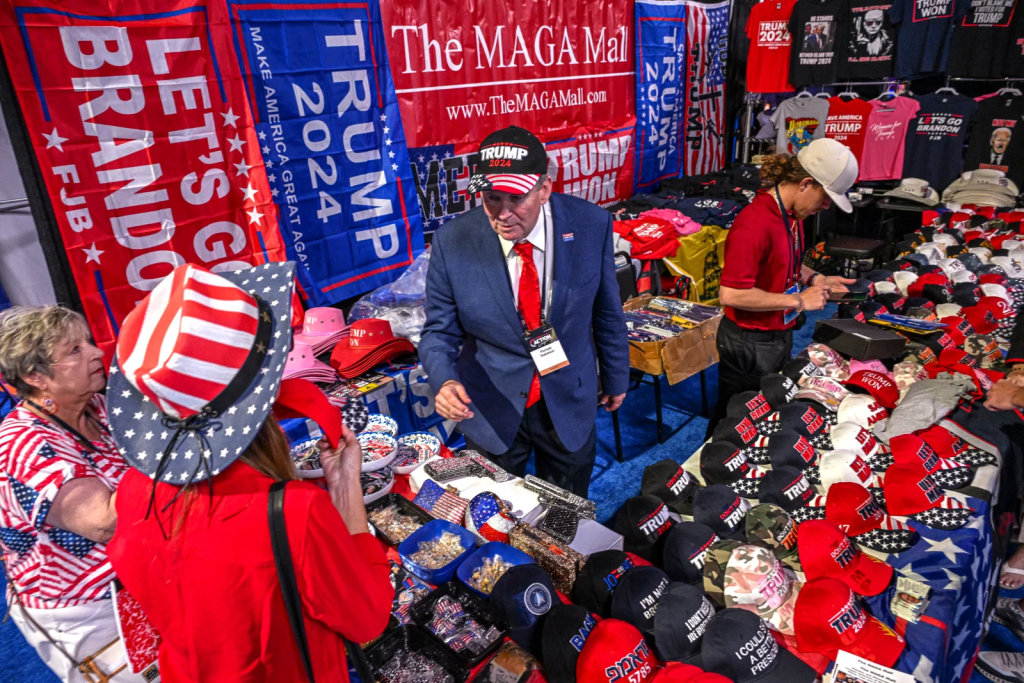
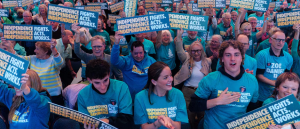
The historical evolution of the slogan serves as a testament to how it can accumulate force. Trump did not invent the language of restoration from nothing, but he transformed it into something much more culturally expansive. What had once been a largely forgotten campaign phrase became, through repetition and branding, a visible political identity. Printed on red hats, banners, shirts and signs, it functioned not simply as persuasion but as affiliation with a broader community. Reuters reported in 2015 that Trump’s campaign was already spending heavily on merchandise such as hats and T-shirts, which helped turn the slogan into a wearable badge of allegiance rather than a mere line in a speech.
Human nature tells us that identity is significantly more durable than argument. A policy position can be revised or forgotten, but a shared identity is harder to dislodge. MAGA did not merely tell supporters what to think about the country – it invited them to imagine themselves as participants in its restoration. Even its opponents reinforced its status by parodying or adapting it, which only confirmed how recognisable it had become. Truly successful slogans pervade and define political culture. In this case, ‘Make America Great Again’ became one of the central markers of a wider nationalist, anti-elite political style.
Read more: The Insight Corner


Say what you like about Trump but whoever came up with those red hats certainly knew what they were doing
Four words and people are still arguing about them ten years later. Pretty remarkable really.
Wasn’t it Reagan’s slogan originally??
It literally says that in the article lol
The word “again” is doing a LOT of work here. Great when? For who?