

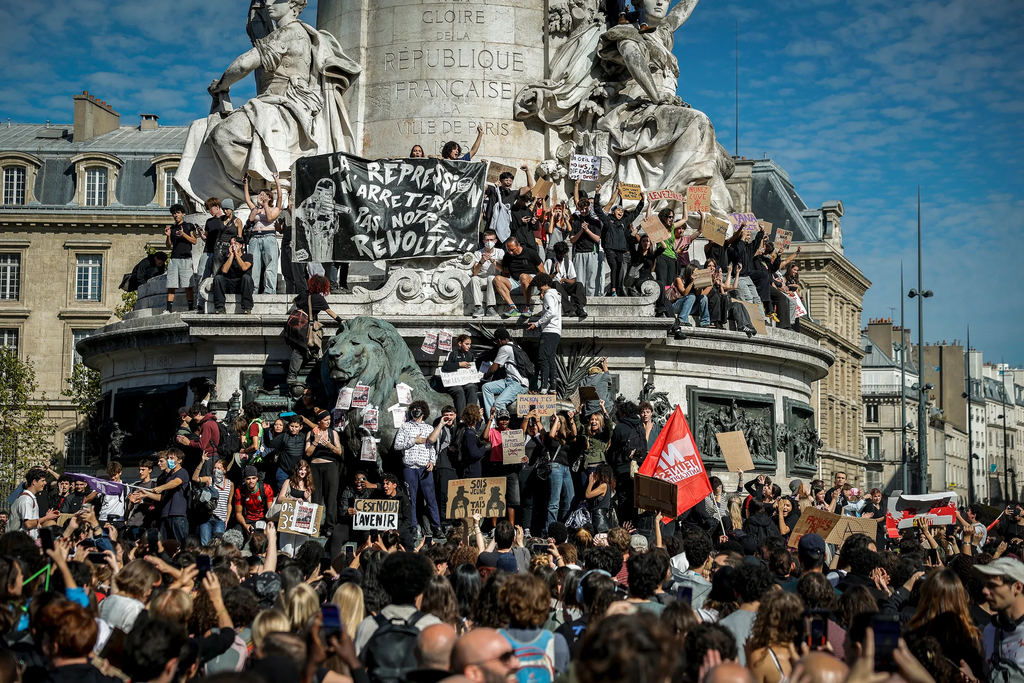
The students who began blocking the gates of Lycée Saint-Exupéry in Créteil last month were protesting something far more elementary than the great abstractions of French politics. Within weeks, demonstrations had spread across the country, accompanied by complaints about overcrowding, deteriorating school buildings and Parcoursup, the university admissions platform that has become a repository for anxieties about the future. By October 1, more than a thousand high schools had been affected. France, a republic that has made equality of opportunity almost a national article of faith, was being confronted by pupils who doubted that the promise applied to them.
There is a peculiar French pride in meritocracy. Since the French Revolution, the ideal of careers open to talent has offered an answer to the privileges of birth. The competitive examination, or concours, became one of the republic’s preferred instruments for separating achievement from inherited rank. In principle, a brilliant child from Seine-Saint-Denis should be able to reach the same institutions as the child of a Parisian minister. France still believes deeply in its grandes écoles, whose graduates populate the senior civil service and business establishment. The trouble begins long before either child sits an examination.
The Inheritance Behind the Exam
In 1964, sociologists Pierre Bourdieu and Jean-Claude Passeron drew attention to precisely this difficulty in Les Héritiers. Families pass on more than money. They pass on familiarity with books, knowledge of which schools matter and a manner of speaking that institutions recognise as cultivated. A selection process can reward these qualities without even knowing about a parent’s occupation. Its rules may be impartial, but the preparation for meeting them is far from evenly distributed.
The figures are difficult to reconcile with the republican ideal. An Institut des politiques publiques study of enrolments in 2016–2017 found that 64% of students at grandes écoles came from very advantaged social backgrounds, compared with 23% of young people aged 20–24. Those from disadvantaged backgrounds made up just 9%, despite accounting for 36% of that age group. Among the most selective tenth of grandes écoles, nearly four in five students came from very advantaged families, exposing just how firmly entrenched this pattern has become. Inequality does not begin at the university gate either. The OECD’s recently released PISA 2025 results found a 100-point gap in science between France’s most and least advantaged quarters of students, against an OECD average of 85 points. When one lycée struggles to replace absent teachers and another offers intensive preparation for elite admissions, describing the eventual ranking as a pure measurement of talent strains credulity. There is little sense in denying differences in ability or effort. There is equally little sense in pretending that all effort has been made under comparable conditions.
Parcoursup and the Illusion of Neutrality
Parcoursup has become an unusually convenient villain for the protests because it gives this unequal contest a single website. More than a million candidates applied through it in 2026. For anxious teenagers, its waiting lists and admissions decisions can feel like a verdict delivered from behind a screen. Despite this popular yet misleading image of an algorithm choosing students is misleading, it is individual institutions that examine and rank applications while the platform merely distributes offers according to those rankings and legal priorities. Removing its logo would hardly resolve the scarcity of sought-after places.
The government has nevertheless promised to replace Parcoursup in 2028. Its October concessions included 15,000 additional higher-education places and plans to cap seconde classes at 28 students, beginning with less advantaged schools. These commitments address genuine problems, although the temptation to confuse administrative renovation with social reform remains considerable. Greater transparency would certainly be welcome. It cannot compensate for years in which pupils have had unequal access to teaching and the guidance needed to imagine themselves at a prestigious institution.

There is another temptation, particularly amid street protests, to regard selectivity itself as the offence. That would be a mistake. France needs excellent engineers, doctors and public administrators, and demanding courses must be allowed to distinguish between applicants. The more important task is ensuring that an able pupil from a struggling school has a realistic route into them. Better replacement teaching, serious academic support before the final school years and admissions practices that recognise achievement in context would do far more for opportunity than declaring competition illegitimate.
What the Republic Owes Its Students
The violence accompanying some demonstrations deserves condemnation, as do blockades that deprive classmates of lessons they cannot easily replace. Those with the fewest alternatives to school are often the first to suffer when school is interrupted. Yet the disorder should not obscure what prompted the original protest. Teachers were missing, and pupils were wondering why a republic so devoted to educational equality could not supply them.
France has an exact phrase for the promise at stake – égalité des chances. It translates as equality of opportunity, though the original French carries the weight of a national creed. The republic has built elaborate institutions for certifying merit, institutions that command admiration well beyond its borders. Their legitimacy depends upon the belief that talent can emerge from anywhere, however modest its origins. An examination can establish who performed best on the day, but a society genuinely committed to meritocracy must take a far greater interest in how they arrived there.



64% from privileged backgrounds. So much for equality of opportunity.
Doesn’t necessarily mean the system is unfair, maybe those students just perform better
Easier to perform better when your school actually has enough teachers…
Sounds like Parcoursup is getting blamed for problems that were around long before it existed.
Why do French students always seem to end up blocking schools? Not sure how missing even more classes helps their situation
Protesting is practically a national sport over there 😂
My cousin went through Parcoursup last year. Spent most of the summer on waiting lists. Absolute nightmare.
France has been having this argument for about 200 years hasn’t it?
Different country, same problem, your postcode still determines a lot about your education in Australia too.
The grandes écoles sound like a very fancy old boys club
Some of them definitely are but plenty of students still get in through sheer hard work.
15,000 extra university places sounds good until you remember there’s over a million applicants
I agree with keeping competitive entrance exams. The answer can’t just be lowering standards every time people complain about the results.