
Every generation of Australians seems to discover anti-Americanism for the first time, certain that its objections are a uniquely justified response to the uniquely bad behaviour of whichever president happens to occupy the White House. Donald Trump’s approval ratings in Australia are now the worst ever recorded for an American president, which mainstream commentary seems to treat as a self-evident verdict: the tariffs, the erratic diplomacy, the war in Iran. Fair enough, as far as it goes. But Australia has experienced this cycle more than once, and the pattern is worth taking seriously precisely because it rarely tracks what the administration actually does. It tracks who is doing it.
A Short History of Selective Outrage
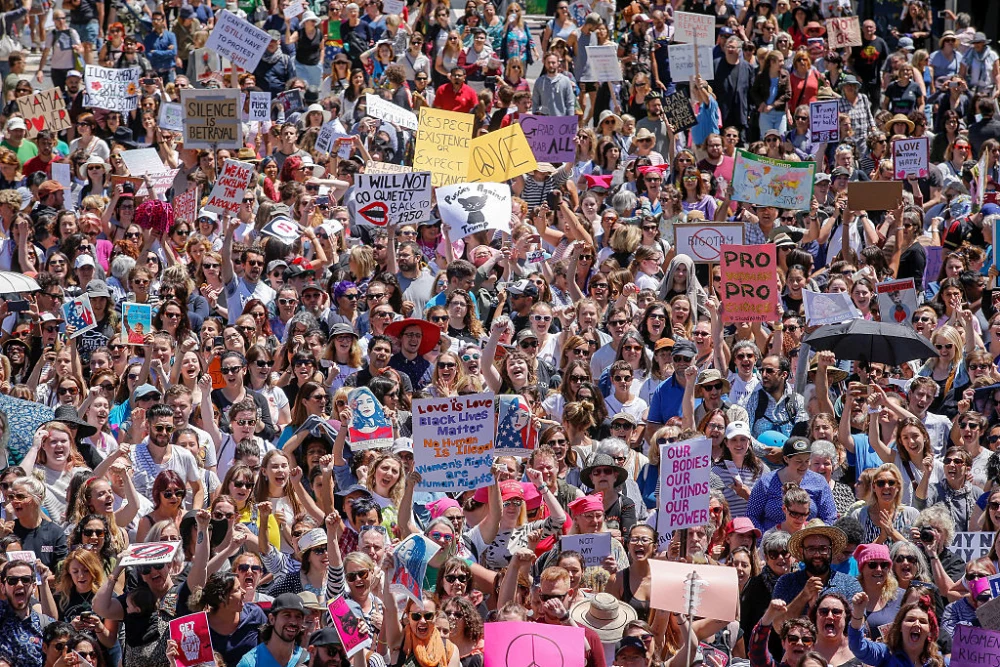
Lyndon B. Johnson visited Australia in 1966 to enormous, adoring crowds; Harold Holt’s pledge to go “all the way with LBJ” was a genuine reflection of public sentiment at the time, not just a prime ministerial flourish. Within a few years, as the Vietnam War continued to drag on under the same basic policy, that mood curdled into moratorium marches involving hundreds of thousands of people. The policy had not fundamentally changed, but the appetite for tolerating it had.
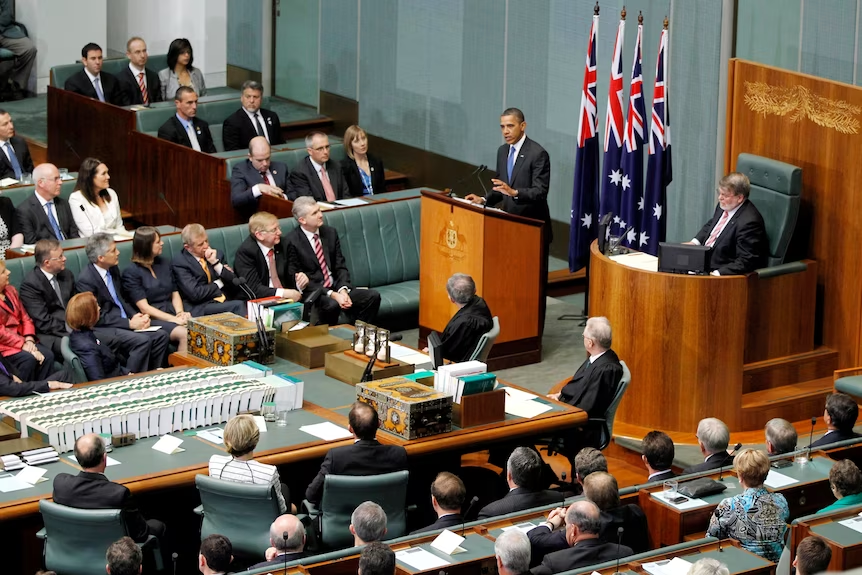
The same rhythm shows up in subsequent decades. Ronald Reagan’s nuclear posture and the fights over American ship visits made him a target of sustained protest through the 1980s, while Bill Clinton, presiding over a similarly assertive foreign policy disguised beneath of a facade of warmer rhetoric, was received in Australia more as a celebrity than a controversial head of state. Fast forward another generation and the pattern repeats with almost comic precision. George W. Bush’s 2003 address to the Parliament of Australia was interrupted by heckling from the crossbench and met with the largest protest marches the country had seen in decades, all because of the Iraq War. Eight years later, Barack Obama addressed the same Parliament to a standing ovation, using the occasion to announce an expanded rotation of US Marines through Darwin, a deepening of exactly the kind of American military presence on Australian soil that had driven people onto the streets under his predecessor. Nobody marched. The alliance infrastructure didn’t retreat under the popular president and advance under the unpopular one; if anything it went the other way. What changed was the man standing at the dispatch box.
A Style Test Dressed Up as a Policy Critique
Obama is a useful case precisely because he complicates the story Australia likes to tell about itself. He expanded drone strikes into significantly more countries than his predecessor, kept Guantanamo Bay open despite promising to close it and left office more popular in Australia than when he arrived. None of that dented his standing here, because he was urbane, self-deprecating, quotable and easy for Australia’s commentariat to imagine having a beer with. Trump pursues American power in a cruder, louder register, and is accordingly treated as a uniquely dangerous rupture in the relationship, not because the underlying question of American military reach is new, but because he is transactional and graceless in a way that Australian society finds intolerable to be associated with. Strip away the personalities, and the actual continuity in what Canberra signs up to, submarines, bases, intelligence sharing, troop rotations, is remarkably stable across both presidencies. Only the public’s tolerance for saying so out loud changes.
The Vocabulary Never Moves
What gives the game away is that the language does not track the swings either. Terms such as “Seppo” and “Yank” and the broader habit of talking about Americans as one undifferentiated mass of loud, overweight, under-informed caricatures, do not disappear during the popular-president years and reappear during the unpopular ones. They sit quietly in the background the whole time, available at dinner parties and in newspaper columns regardless of who is in the Oval Office, aimed less at any specific administration than at Americans as a people. That contempt was always a fixed cultural attitude that each new president simply gives Australians a fresh, respectable-sounding pretext to voice.
What Consistency Would Actually Look Like
None of this means Trump’s specific decisions are beyond criticism; plenty of them deserve it on their own terms. But a reasonable society should apply the same moral standards to a president it likes as to one it does not. If an expanding American military footprint and an assertive foreign policy were acceptable, even admirable, when the man announcing them was charming, they do not become civilisational emergencies purely because his successor is boorish. What Australia produces roughly once a decade is not policy analysis so much as a referendum on presidential manners, dressed in the language of principle. It’s worth naming as such, because in a few years there will likely be a more polished occupant of the White House pursuing plenty of the same policies Trump is being pilloried for now, and the outrage will evaporate just as fast as it arrived.
Read more: The Insight Corner



The Obama comparison is interesting. Don’t remember many protests about the Marines in Darwin.
Being critical of the US government isn’t the same as hating Americans
Nobody said it was. Read the article.
I’ve been to the States a few times and the people were genuinely lovely, couldn’t care less about their politics though.
Not sure I agree with the Vietnam example. Public opinion changed because the war dragged on and people were dying, not just because everyone suddenly disliked LBJ.
Australians spend an awful lot of time discussing a country 15,000km away