Spoken by some 800,000 people in the Pyrenees mountains between Spain and France, Basque is one of the most unique and bizarre languages that exists anywhere in the world. It is one of the few remaining language isolates and the very last in Europe, meaning it demonstrates no identifiable relationship with any other language and is very much one of a kind. The uniqueness of the Basque language has made it the subject of intense speculation and investigation for centuries. Even to this day, a definitive explanation for its origins has yet to be presented. It is very much a remnant of a bygone era and is the last surviving Paleo-European language still spoken today, after the arrival of Indo-Europeans from the Eurasian Steppe during the Bronze Age wiped out almost all of its relatives.
Basque is the single oldest language in the entirety of the Europe that has withstood the conquests of history and the passage of time, even as Romance languages such as French, Italian, Portuguese and Spanish gained prominence and took over the continent. The existence of Basque today is in itself remarkable, as it is the only language to have endured across millennia in a continent as socially, culturally and linguistically hostile as Europe. As the linguist Luis Michelena famously said, “the real mystery in the history of the Basque language is not its origin, but its survival to the present day”.
History of the Basque Country
So how did Basque survive for so long when every other language of its time went extinct? To find the answer, we must first look to history. An estimated 35,000 years ago in the Paleolithic period, the first wave of modern humans to arrive in Europe known as Cro-Magnons settled the lands of today’s Basque Country on the border between Spain and France. These people spoke Paleo-European languages such as Basque, which dominated the European continent for millennia. The Cro-Magnons subsequently spread through much of Iberia, Ireland, Italy, northern Germany and Ukraine. But this was short-lived.
The invasion of Europe by Indo-Europeans from the Eurasian Steppe completely wiped out the Paleo-European class of languages that was once so prevalent, replacing it with the Indo-European languages whose descendants, such as English, French, Latin, Russian and Spanish, would end up taking over the world. The overwhelming dominance of the Indo-Europeans caused much of the Paleo-European languages to fade into history, and they remain largely a mystery even today.
Geography of the Basque Country
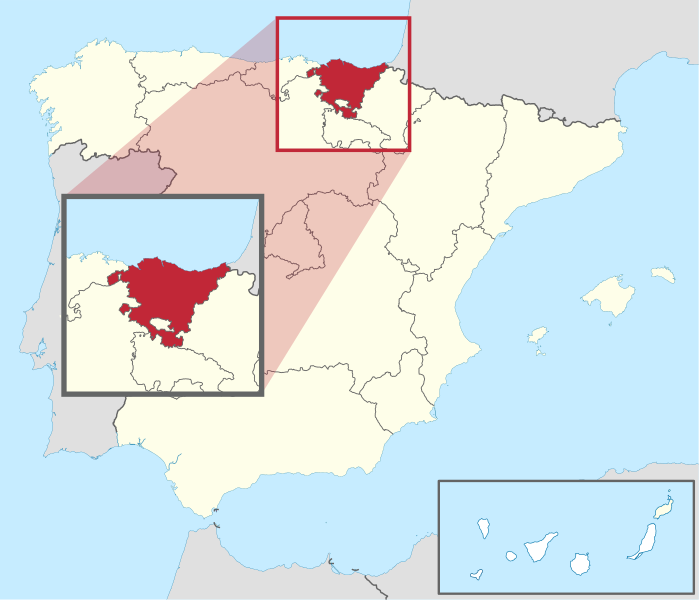
The unique geography of the Basque Country meant that the mass migrations of the Bronze Age did not really affect it. The Basque Country, for one, is located within the Pyrenees, a vast mountain range that isolated its people from the Indo-European cultures in the rest of Europe. It is also on the far western end of the continent, which allowed it to remain almost completely untouched for much of its history. This made the tribes inhabiting the Basque Country the last Paleo-European civilisations to advance to the Iron Age, when they created intricate works of pottery and vast megalithic structures. The extensive construction of defensive settlements throughout the region likely contributed to the longevity of the Basque culture, as invaders would have experienced difficulty in passing through these points of difficult access. Far more impressive, however, was its survival during the rise of the Roman Empire.
Roman Influence
In the 1st century BC, Roman general Pompey established the city of Pamplona on the outskirts of the Basque Country, one of the first Roman settlements in the Pyrenees. Apart from a conquest of local tribes carried out in 65 BC by Crasus, Julius Caesar’s lieutenant, the northern Iberian peninsula remained largely untouched by Rome for several decades. But this would soon change.
After his victory against Mark Antony and Cleopatra in the Battle of Actium in 31 BC, Augustus became the first emperor of the Roman Empire and immediately set out to conquer the entirety of the Iberian peninsula. Although the Romans ultimately reached the Basque Country and encountered the Vascones, the ancestors of the modern-day Basques, they considered the land to be mostly useless and made no effort made to establish a permanent settlement there. While the Romans focused on maintaining a presence along the Atlantic and Mediterranean coasts of Iberia, the Vascones continued to reside in the Basque Country, largely free of Roman influence and rule.
Much of the region broke free from the control of the Roman Empire in a series of revolts throughout the 5th century, and it was in this way that the culture and language of the Basques escaped the grasp of the single most absolute, unrivalled power in European history. Although the Romans failed to wipe out the Basque language, they influenced it to a great extent. The written form of modern-day Basque uses the Latin alphabet, and up to 40% of its vocabulary likely originates from the Romance languages, the descendants of Latin. Perhaps Basque’s unique ability to take on features of more dominant languages has allowed it to remain relevant throughout history and stand the test of time.
Aquitanian
The Basque Country is one of the most dialectally diverse regions in all of Europe, with eight distinct dialects of Basque still existing today. Despite the dramatic differences in pronunciation, however, they remain mutually intelligible and provide relatively minimal insight into the origins of the language. While the precise classification of Basque continues to serve as a highly contentious subject, linguists have identified a number of lesser-known extinct languages that belonged to the same family tree.
Archaeologists recently discovered a series of Latin inscriptions in the Roman province of Gallia Aquitania in southwest France which reveal the existence of a Paleo-European language known as Aquitanian, an ancestor of modern-day Basque spoken south of the Pyrenees. Aquitanian was likely the dominant language of the Basque Country during the Roman occupation of Iberia, with the region’s comparative neglect by the Romans allowing it to survive and ultimately evolve into Basque. The similarities between words in Aquitanian and Basque can be seen in the table below.
Similarities Between Aquitanian and Basque
| Aquitanian | Proto-Basque | Basque | Basque meaning |
|---|---|---|---|
| adin | *adiN | adin | age, judgment |
| andere, er(h)e | *andere | andre | lady, woman |
| andos(s), andox | *andoś | lord | |
| arix | *aris | aritz | oak |
| artahe, artehe | *artehe | arte | holm oak |
| atta | *aTa | aita | father |
| belex | ?*beLe | bele | crow |
| bels | *bels | beltz | black |
| bihox, bihos | *bihos | bihotz | heart |
| bon, -pon | *boN | on | good |
| bors | *bors | bost | five |
| cis(s)on, gison | *gisoN | gizon | man |
| -c(c)o | *-Ko | -ko | diminutive suffix |
| corri, gorri | *goRi | gorri | red |
| hals- | *hals | haltza | alder |
| han(n)a | ?*aNane | anaia | brother |
| har-, -ar | *aR | ar | male |
| hars- | *hars | hartz | bear |
| heraus- | *herauś | herauts | boar |
| il(l)un, ilur | *iLun | il(h)un | dark |
| leher | *leheR | leher | pine |
| nescato | *neśka | neska, neskato | girl, young woman |
| ombe, umme | *unbe | ume | child |
| oxson, osson | *otso | otso | wolf |
| sahar | *sahaR | zahar | old |
| sembe | *senbe | seme | son |
| seni | *śeni | sein | boy |
| -ten | *-teN | -ten | diminutive suffix (fossilized) |
| -t(t)o | *-To | -t(t)o | diminutive suffix |
| -x(s)o | *-tso | -txo,-txu | diminutive suffix |
Iberian
A language known as Iberian, spoken from the 7th to the 1st century BC in southeastern Iberia, is another potential relative of Basque. This can be seen in the distinct similarities shared between their respective vocabulary and numerical systems. For example, the suffixes -sken and -ken on Iberian coins bear great resemblance to the endings seen in modern Basque, while the ili observed in the names of Iberian towns is similar to the word hiri in Basque, meaning town. Despite these striking similarities in vocabulary, it remains unclear whether this is actually due to a linguistic relation between the two languages or simply an outcome of interactions between the Iberians and the Vascones that caused Iberian loanwords to be introduced to Basque.
Revitalisation
The Basque language was in a state of decline until the Renaissance, a monumental turning point in European history. This ‘revival’ of the ideas and achievements observed in classical antiquity (ancient Greece and Rome) finally spread to isolated regions such as the Basque Country, which resulted in the revitalisation of many elements of Basque culture. French explorer Antoine d’Abbadie organised a series of poetry competitions known as Juegos Florales, which promoted the Basque language in the eyes of a broader European audience. This competition set the revival of modern Basque into motion, with the Basque Studies Society being established in 1918 and the Basque Language Academy in 1919.
Although it suffered neglect when military general Francisco Franco took over Spain in World War II, Basque has since become the focus of intense revitalisation efforts throughout the region. The integration of Basque into the education system, the establishment of institutions promoting the language as well as the popularisation of Basque media has resulted in an increasing number of people learning to speak the language every year. Surveys have revealed that 30.6% of the population in the Basque Country spoke Basque in 2021, compared to just 22.3% in 1991. The Basque language has faced countless formidable challenges that brought it to the brink of extinction more than once, yet it has managed to recover every single time. In a world filled with empires, conquest and far more dominant languages, the survival of Basque through the ages is no short of incredible.
Read more: The Insight Corner