Few phrases in political commentary do as much work for as little evidence as ‘echo chamber.’ The left deploys it against Rupert Murdoch and the Facebook algorithm, while the right uses it against the legacy press and universities. Each side is certain the other lives in one, yet almost nobody stops to consider about what it actually means. The term can be attributed to two people: legal scholar Cass Sunstein feared the ‘echo chambers’ that people build for themselves, while author Eli Pariser warned of the ‘filter bubbles’ that algorithms build for them. Both metaphors imagine a sealed space with a passive occupant. So it is worth asking, as empirically as a personal blog can, whether such an enclosure truly exists. The short answer is that the version imagined by popular culture largely does not, but a narrower and more troubling version does.
The bubble that mostly isn’t
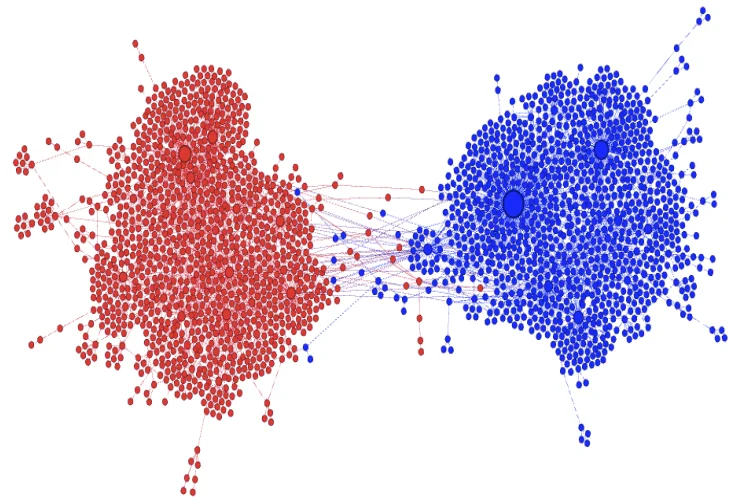
A major Reuters Institute review found that echo chambers were far rarer than the public debate assumes and discovered no evidence at all for the concept of the ‘filter bubble’. This is not a new result. In 2011, economists Matthew Gentzkow and Jesse Shapiro found that online news diets were only mildly segregated by ideology, slightly more than most traditional media outlets but significantly less than the company we actually keep, whether neighbours, colleagues or relatives. Closer to home in Brisbane, media scholar Axel Bruns mapped the interactions of nearly four million Australian Twitter accounts and found bubbles scarce. He also observed that the thesis generally rings true to politicians and journalists, who have themselves been accused of living in bubbles, while the evidence for ordinary users is far thinner.

Exposure is not the cure
If the bubble were the problem, popping it should help. Among the largest tests came from the 2020 Facebook and Instagram Election Study, which found that the median user saw about half their feed from sources sharing their politics, against under 15% from the other side, though political news was only a small fraction of everything they saw. When researchers reduced that congenial content by about a third for more than 23,000 users, eight measures of attitudes, including polarisation, did not measurably move. Sociologist Chris Bail’s Twitter experiment went further, paying users to follow a bot that retweeted the other side. Republicans who did so for a month became substantially more conservative, while Democrats shifted slightly the other way, though not significantly. Such evidence cuts against the most popular remedy, a nudge toward more diverse feeds.
One word, two meanings
Philosopher C. Thi Nguyen supplies a distinction that clears much of the fog. A bubble is a gap in what you hear, while a chamber is a verdict on who deserves to be heard. Bubbles pop easily, since new voices are all it take, but chambers resist, and exposure to outsiders can even deepen a member’s confidence in their own side’s sources. That reconciles the evidence. The metaphor we all use describes bubbles, which are less common than assumed and easily popped, while the genuine harm lies in trust, which more exposure cannot reliably repair.
Nguyen’s own empirical anchor, professors Kathleen Jamieson and Joseph Cappella’s study of how echo chambers function, examined political commentator Rush Limbaugh and his place in the conservative media world. The Facebook data revealed that a sizeable portion of the news ecosystem was read solely by conservatives, and that most of what Meta’s fact checkers flagged as false lived there, with nothing comparable on the liberal side. Admittedly, the finding rests on one platform, one election and a definition of misinformation that reasonable people can contest, but it should temper any temptation to wave the whole subject away.
The accusation as a weapon
This brings us to the phrase’s second job. ‘You live in an echo chamber’ is seldom an empirical claim. It explains disagreement as a defect in the other person’s information diet, sparing the speaker the labour of answering the argument. And if bubbles do exist, the evidence points offline, to the suburb, the workplace, the professional class. Gentzkow and Shapiro’s finding about neighbours and colleagues points that way, and so does Bruns’ aside about politicians and journalists. Parliament House and the press gallery are small, physically concentrated communities, which makes them at least a plausible candidate.
The better question is not what someone reads but whom they trust. One test, from UnHerd’s gloss on Nguyen, is whether we extends outsiders good faith by default, and whether our own side’s sources face the scrutiny applied to others. On the evidence, most of us are not trapped by an algorithm. We are only as open as the standard we apply when someone disagrees. The phrase deserves retirement, or at least precision – next time someone reaches for it, ask them exactly what they mean.
Read more: The Insight Corner